A 5-day boat show can generate hundreds of contacts. Enthusiasts who stop by your stand, ask questions, get excited about a model. Some leave their business card. Others walk away with a brochure and the vague promise to "stay in touch".
Then the show ends. Stands are taken down. Teams head home, exhausted. And the most critical, and most neglected, phase of the sales cycle begins: the follow-up.
The numbers speak for themselves: according to industry estimates, 80% of contacts captured at boat shows are never followed up in any structured way. Interested prospects, sometimes ready to buy, fall through the cracks for lack of an effective tracking system.
This article lays out a complete method to stop losing a single lead, from handshake to closing.
The hot / warm / cold framework
Not all leads are created equal. Treating a curious visitor the same way as a buyer ready to sign is a waste of time and energy. The first step in effective management is categorisation.
Hot lead
The visitor has a concrete short-term project (less than 3 months). They've spent time on the stand, asked specific questions about options and financing, requested a quote. They're identified as a potential buyer.
- Signals: quote request, questions about delivery times, financing discussion
- Action: follow up within 24h, phone call, sea trial proposal
Warm lead
The visitor is interested but has no immediate project. They're exploring, comparing, gathering information. Their buying horizon is 6 to 12 months. They've shown interest but haven't asked for a quote.
- Signals: questions about models, taking photos, voluntary contact exchange
- Action: send the configuration by email, monthly nurturing, invitation to the next show
Cold lead
The visitor passed by quickly, picked up a brochure or left an email out of politeness. No identified project, but they've entered your sphere.
- Signals: brief visit, general questions, no quote request
- Action: quarterly newsletter, inspirational content, reactivation before the next show
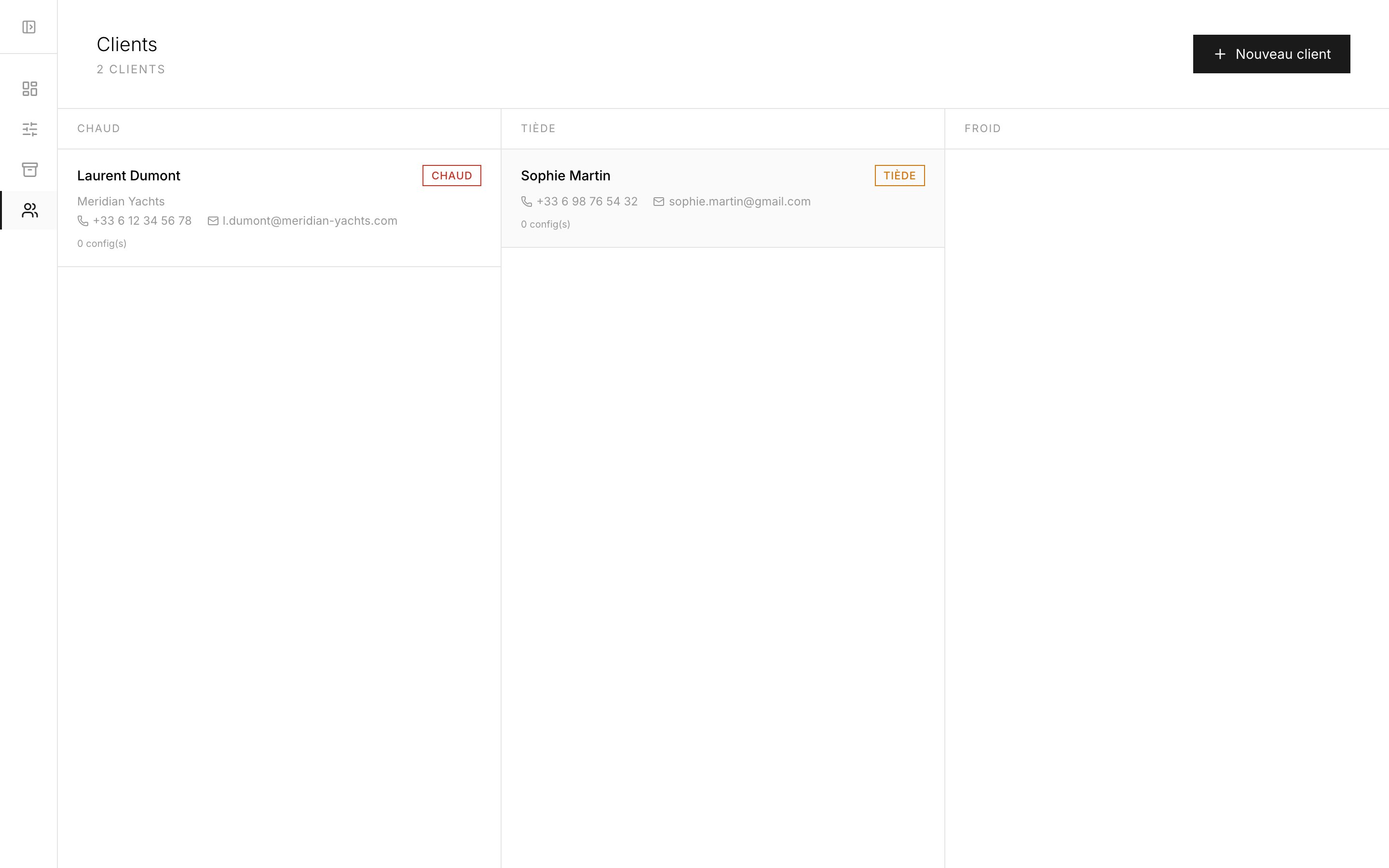
This categorisation must happen in real time, during the show, not two weeks later. That's why a tool like the Nautime visual board (3 columns hot/warm/cold) is so effective: classification happens with a single gesture, right in the middle of the conversation.
On-stand capture: what to note, and when
The moment of capture is critical. Too early, you interrupt the conversation. Too late, you forget the details. Here's a 4-point protocol:
1. During the configuration
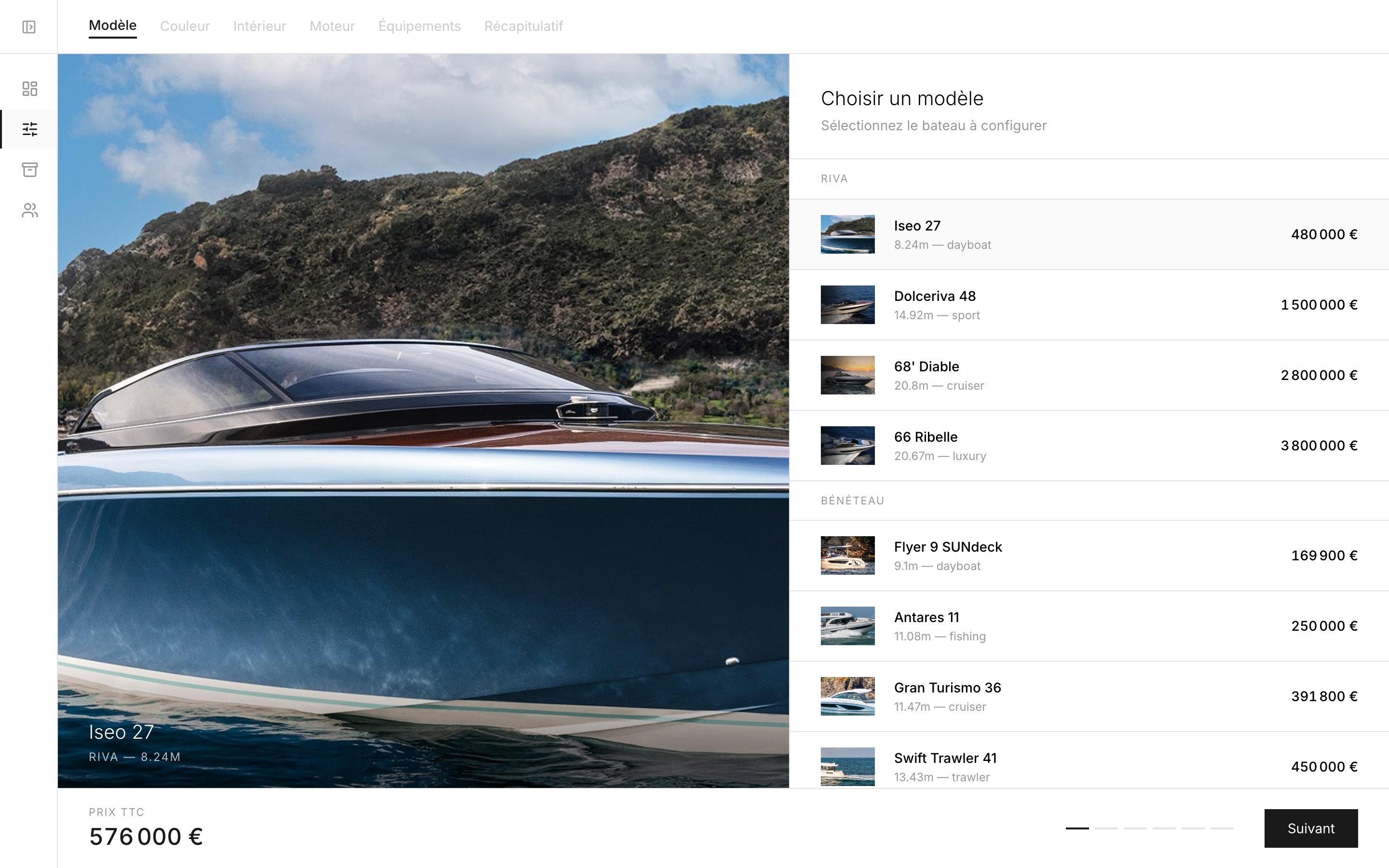
If you use a tablet configurator, capture happens naturally. While the client chooses their options, you create their record in the background. The configuration is automatically attached to the lead.
2. The essential information
- First and last name (mandatory)
- Email (mandatory, it's the main follow-up channel)
- Phone (if the lead is hot)
- Temperature: hot, warm or cold
- Quick note: 1-2 sentences on what interests them ("couple, first boat, budget 150K, interested in the GT 36")
3. What NOT to do
- Ask people to fill out a paper form (maximum friction)
- Collect business cards without digitising them (lost within 48h)
- Postpone data entry "to tonight at the hotel" (you'll have forgotten the details)
4. Entry time
With a good tool, the client record is created in 15 seconds. That's the time it takes the client to pull out their phone to exchange contact details. No friction, no break in the conversation.
The critical window: the 48 hours after the show
Studies on buying behaviour are unanimous: a prospect's interest decays exponentially after an event. After 48 hours, the memory of your stand starts blending with those of the competitors they visited.
Here's the ideal post-show follow-up timeline:
Day 0 (that very evening)
Automated email for hot leads: "Thank you for your visit. Here is your configuration and your quote". Include the link to the personalised configuration. The client instantly finds again what they built with you.
Day 1 to Day 2
Phone call for every hot lead. The goal isn't to sell over the phone, it's to confirm interest and plan the next step (sea trial, dealership visit, meeting with the financial advisor).
Day 3
Email for warm leads with the configuration + value-added content (model spec sheet, buying guide, presentation video). No sales pressure, just useful content.
Day 7
Gentle follow-up for hot leads who haven't replied. "Have you had a chance to look at your configuration? Any questions about options or financing?"
Day 14
First touchpoint for cold leads. Newsletter or content email: "Boating trends in 2026", "How to choose your first engine". The goal is to keep your brand front of mind for the prospect.
Personalised follow-up: the configurator advantage
The difference between a generic follow-up ("Following your visit to our stand...") and a personalised one is massive in terms of open rate and conversion.
When every lead is attached to a precise configuration, the follow-up naturally becomes personalised:
- "Here is your Riva Iseo 27 with the midnight blue hull and the options you chose"
- "You were hesitating between the 300hp and the 350hp engine, here's the detailed comparison"
- "The colour you liked is available for a spring delivery"
The client feels recognised, not solicited. The follow-up is a service, not an intrusion. And the link to their configuration lets them pick up exactly where they left off, with no account creation, no need to redo their choices.
Measuring ROI: the metrics that matter
Structured lead management finally lets you measure the effectiveness of every show. Here are the KPIs to track:
- Number of leads captured per show (and per day), target: 100% of conversations result in a record
- Hot / warm / cold split, a healthy ratio is roughly 20% hot, 40% warm, 40% cold
- Follow-up rate, target: 100% of hot leads contacted within 48h
- Lead → quote conversion rate, marine benchmark: 30-40% of hot leads
- Quote → sale conversion rate, marine benchmark: 15-25%
- Cost per lead, divide the show budget (stand, travel, team) by the number of leads captured
- Revenue per show, track sales attributable to each show over 12 months
These metrics, tracked from one show to the next, let you progressively optimise your presence: which shows are most profitable, how many salespeople to deploy, which models to put forward.
Conclusion: every lead is an investment
The cost of acquiring a lead at a boat show is high. Between the stand, the boats on display, transport, accommodation and your team's time, every conversation with a visitor represents an investment of several dozen euros. Leaving 80% of these contacts without follow-up is literally throwing money away.
The good news: structuring your lead management doesn't require a 50,000-euro CRM. A simple, visual tool integrated into the on-show sales flow, like the Nautime lead board, is enough to transform your conversion rate.
Boat shows only last a few days a year. But the leads they generate can fuel your pipeline for months. Provided you don't let them slip away.
Want to see how Nautime captures and tracks leads at boat shows? Request a personalised demo, 20 minutes, no commitment.