By 2026, most major boat builders have rolled out a configurator. Yet behind the variety of interfaces, a single technology has taken over everywhere: real-time 3D. This overview tours the available solutions, from the proprietary configurators of the largest builders to third-party SaaS platforms, and highlights the shared limitations that weigh especially heavily on the high-end segment.
Builders' proprietary configurators
Every self-respecting major builder now has a configurator embedded in its website. The philosophy is the same: hand customers control over colours, options and layouts so they can picture the boat before ever stepping into a dealership. Investments range from a few tens of thousands of euros for the most modest tools to several million for the most ambitious.
Princess Yachts / REALTIME
Unveiled as a world première at the Cannes Yachting Festival 2025, REALTIME is Princess Yachts' immersive 3D configurator. The project was framed as a technological leap forward in the yachting world, with real-time photographic 3D and interactive 360° views.
Strength: undeniable wow factor on the stand, 3D quality among the most advanced in the sector, and consistency with the Princess DNA. The investment matches the brand.
Limit: despite its rendering quality, REALTIME remains a synthetic image. The grain of fine joinery, the depth of a lacquer finish, the softness of leather are still visual approximations. The tool is technically heavy, demands a solid connection, and is built first for corporate marketing rather than for field sales.
Hanse Yachts / QUEO
Hanse Yachts' QUEO configurator is one of the first nautical web configurators to win international recognition: Gold Stevie Awards 2022 and the German Digital Award (BVDW) the same year. Deployed as a PWA, it covers the full range with around 30 options and 70 variants per model.
Strength: maturity, stability and refined ergonomics. QUEO is one of the cleanest case studies of a 3D web configurator in the marine industry.
Limit: classic 3D technology shows its limits in the details. Colour or interior variants remain visually close, because the modelling cannot reach the level of finesse that a photograph or a photoreal render can deliver.
Web configurators of the major volume builders
Beneteau, Jeanneau, Bavaria, Dufour, Lagoon, Fountaine Pajot: all of them now offer a configurator embedded in their site. The technology is almost universally the same: real-time WebGL 3D, with selectable finish and layout variants.
Strength: range coverage, accessibility from the website, and natural integration into the marketing journey.
Limit: performance depends on the visitor's hardware (sluggish on mobile, frequent cases of endless loading), often approximate rendering at close zoom, and weak visual differentiation between two similar configurations. These configurators are designed for web marketing, not for a live demo facing a customer at a boat show.
Third-party SaaS solutions
Alongside proprietary configurators, a small ecosystem of SaaS solutions has emerged for builders that cannot or do not want to develop one in house.
MDS ModelMixer
Named Boating Industry Top Product 2025, MDS ModelMixer is a modular platform that offers three configurator tiers: Static (images), 2D (pseudo-interactive) and 3D with augmented reality. The positioning is clear: give every builder an entry point matched to its budget.
Strength: a flexible offering, the ability to start small and scale up, and a solid vendor ecosystem.
Limit: the 3D tier is still classic 3D, technically correct but lacking texture. A multi-brand positioning that dilutes each builder's visual identity.
Boatconfigurator.com
A German vendor, Boatconfigurator.com targets mid-sized builders and dealerships with an accessible web configurator. Lower price, simpler integration, but a basic visual rendering.
Strength: financial accessibility and fast deployment.
Limit: a generic visual rendering, clearly unsuited to high-end positioning.
iNautia
A Spanish platform that combines boat listings with light configuration. Closer to an enriched catalogue than a true interactive configurator, iNautia is mostly active on the Iberian market.
"In-house" configurators and Excel sheets
The overview would not be complete without acknowledging the reality at many smaller builders, including in the high end: no configurator at all. Options are listed in a PDF, prices calculated on a spreadsheet, and the quote sent by email several days after the first contact.
This situation affects a significant share of low-volume bespoke builders, exactly where the demand for personalisation is the highest. The customer expects visuals worthy of the price about to be paid, and gets a spreadsheet. The disconnect between the product and the sales tool is at its peak.
What all these configurators share
Stepping back from individual comparison to look at the market as a whole, one observation stands out: every available configurator relies on the same technological family, real-time 3D. The variations play out in modelling refinement, fluidity and available options, but the paradigm is the same.
And that paradigm, however technically impressive, carries structural limits that bear especially hard on the high-end segment:
- Synthetic rendering. A 3D image, even an excellent one, remains a synthesis. It cannot reproduce the real grain of oiled teak, the vibration of brushed stainless steel, the depth of a lacquer finish, or the patina of full-grain leather. Yet that is precisely what creates the perceived value of a yacht worth several hundred thousand euros.
- Slowness. Loading a full 3D model takes several seconds, sometimes several dozen on mobile. In a boat-show setting, facing a customer, that wait is enough to lose attention and break the commercial momentum.
- Production cost. Every new model, every new variant has to be precisely modelled. Budgets quickly run into hundreds of thousands of euros per range, on top of the recurring technological maintenance.
- Weak visual differentiation. Between two configurations, customers often struggle to see the real difference, because 3D smooths over the rough edges that make a finish choice meaningful.
For a volume builder, these limits are acceptable: the priority is range coverage and web interaction. For a high-end builder selling a dream and an exceptional product, they are problematic. The most advanced sales tool in the sector still fails to do justice to the product it is meant to sell.
Breaking out of the 3D paradigm: the Nautime angle
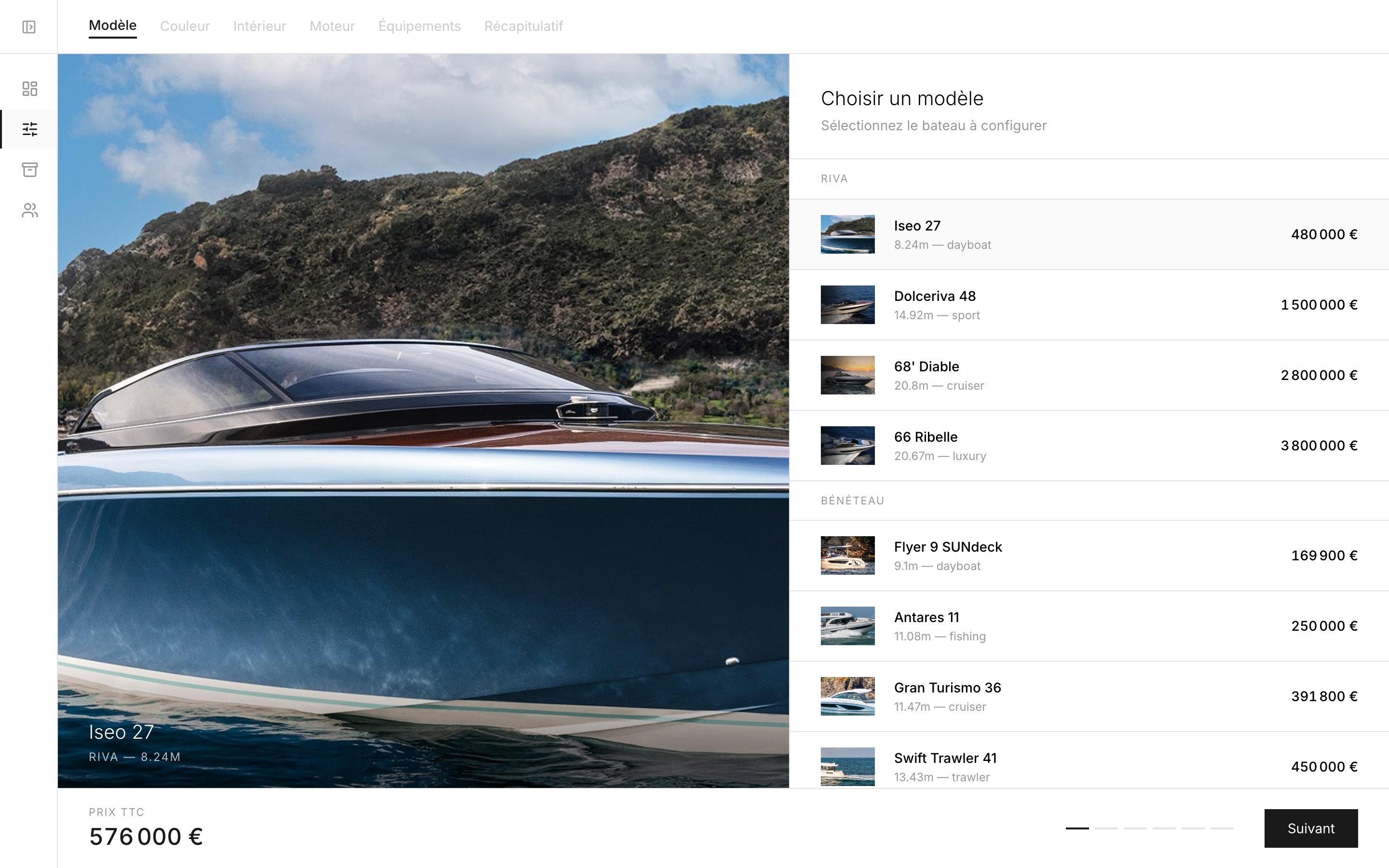
Nautime was built around a different conviction: the visuals of a high-end configurator must be photoreal, not synthetic. Our proprietary rendering technology, trained on our marine references, makes that ambition concretely possible for the first time in the marine industry.
The approach rests on three pillars:
- Bespoke photoreal rendering. Starting from source photos supplied by the builder, our proprietary rendering pipelines produce the visuals for every possible configuration: photorealistic variants for colours and materials, detail views on the finishes, cinematic video sequences for transitions. The result is faithful to the actual product, not to a 3D model. The grain of materials, the truth of colours and the depth of finishes all come through.
- An ultra-fast tablet journey. No 3D to load, no WebGL to initialise. The full journey takes 3 minutes on an iPad, in any context (showroom, boat show, on the move). Cinematic transitions between steps, an instantly generated PDF quote, and built-in lead capture.
- An openly high-end positioning. Nautime is not a generic tool. The interface, typography and visual design are crafted to fit the DNA of a premium builder, not a multi-brand SaaS framework.
Side-by-side comparison
To close this overview, a summary table that places Nautime within the landscape:
| Solution | Technology | Rendering | Target |
|---|---|---|---|
| Princess REALTIME | Real-time 3D | Photographic 3D | Princess (proprietary) |
| Hanse QUEO | WebGL 3D (PWA) | Classic 3D | Hanse Group (proprietary) |
| MDS ModelMixer | Static / 2D / 3D | Classic 3D | Multi-builder SaaS |
| Beneteau, Jeanneau, Lagoon, FP configurators | WebGL 3D | Classic 3D | Volume builders |
| Boatconfigurator.com | Web 2D / 3D | Basic | Mid-sized builders |
| Nautime | Proprietary rendering (photorealistic variants + cinematic transitions) | Photoreal | High-end yachts |
How to pick your configurator in 2026
For a builder evaluating its configuration strategy today, a few structuring questions:
- Are the visuals worthy of my product? If the boat sells for 500K, 1M or more, a generic synthetic image is in direct contradiction with the value proposition.
- Can the tool actually be used at a boat show, facing a customer? A web marketing configurator is not a field sales configurator. The two briefs are different, and most current tools only address the first one.
- Is the total cost (production, maintenance, modelling of new models) sustainable over time? 3D demands a continuous investment with every evolution of the range.
- Does the visual identity stay under my control? Multi-brand SaaS solutions inevitably dilute each builder's DNA.
The market is shifting. After a decade dominated by 3D, photoreal cinematic rendering is opening a new chapter, where visual rendering ceases to be a technological constraint and becomes once again an aesthetic choice in service of the product.
Curious to see what a photoreal configurator looks like in your hands? Request a personalised demo. 20 minutes, no commitment.